

Fenruary 24, 2026
by Francesco Ramella
As the story foes, there are no free rides. The costs of each journey must necessarily be borne by someone. They can be broken down into three categories:
- the monetary costs related to the construction, maintenance and management of infrastructures;
- the monetary costs related to the purchase and use of vehicles;
- the costs that arise from the negative impacts that vehicles have on third parties such as noise, air pollution and accidents.
While in the early modern period private companies were often the main actors, in recent decades, the construction and management of infrastructures have been mainly handled by the state and local governments. A part of the motorway network and some major airports and ports are exceptions.
As regards road transportation, the purchase and maintenance of vehicles are borne by private individuals and companies; state incentives have occasionally been provided. This sector is heavily taxed. In Europe, tax revenues from motor vehicles is around 500 billion euros per year. Roughly half of the revenues come from fuel taxation which represents about half or more of the price paid by consumers. These revenues are far higher than the public expenditure on the construction and management of roads. In Italy, for example, yearly revenues are about 75 billion Euros (of which 60 billion are excise taxes). Expenditures are lower than 20 billion Euros.
Air and sea transport users essentially bear all the operating costs of the vehicles and those of the infrastructures.
The situation is radically different for rail and local public transport. The price paid by users never covers the construction costs and only a portion of the operating and maintenance costs of the infrastructures. For most long-distance trips, commercial revenues cover the operating costs of the services, while in the case of urban and suburban services operated by metro, trams and buses public subsidies cover approximately two thirds of the costs. Users bear the full cost only for the bus services in the UK metropolitan areas after the deregulation in 1986 1986) and, also in the UK, for the the railway services between 2010 and 2019.
The annual cost to European taxpayers of transfers to railway companies is around 80 billion euros. French taxpayers are hit particularly hard: the burden rose from 12.9 billion Euros in 2014 to 21.2 billion Euros in 2023 (Figure 1). Beside direct costs, contributions are made to offset the deficit in the railway pension fund, equal to €3.5 billion annually (Italy has an even worse situation with a €5 billion contribution).
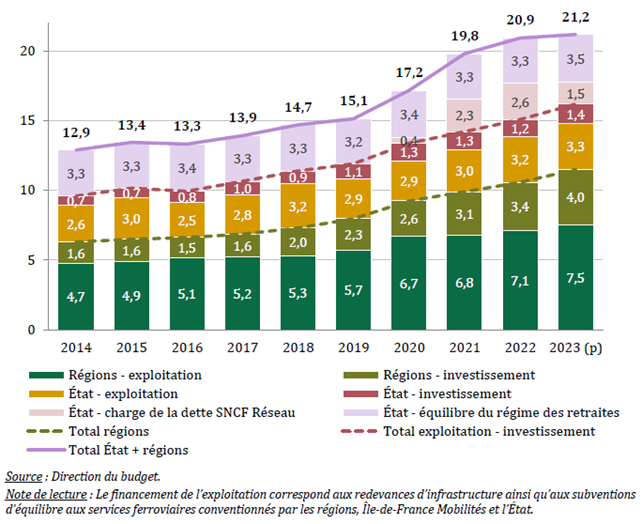
Figure 1: State financial contributions to the SNCF group, 2014–2023 (in current € billion)
The authorities offer many reasons to justify such expenditure. They include fostering economic growth, redistribution and environmental sustainability. The first point is far from obvious. For example, the years of strongest growth in Western European countries were those around the 1950s and 1960s, during which the railway was progressively marginalised, and that the same thing happened in Eastern Europe, where rail transport collapsed after the fall of the Berlin Wall (see Figure 2 for Poland).
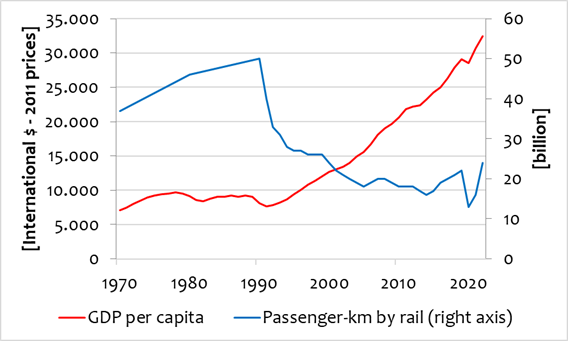
Figure 2: GDP per capita and passenger rail mobility in Poland from 1970 to 2022
Source: Own elaboration with data from Eurostat and Ourworldindata.org
The argument about redistribution is also questionable. For example, a great many people who are not poor use the highly subsidized trains, while many low-income people live in peripheral areas and mainly travel by car, which is subject to high taxation.
As for sustainability, it is true that on average (but not always, think about a semi-empty train), rail transport is less polluting than cars, trucks and planes. But this fact would be relevant to transport policies only if subsidies and public investments achieved a significant shift in demand towards rail. In fact, such shift did not take place: today, the “market” share of the rail is only a few percentage points – and there is no reason to think this share will rise significantly in the future.
Moreover, since the 1970s, there have been major technological advances leading to a sharp reduction of air pollutant emissions and, to a lower extent, of energy consumption and noise from cars and trucks. In brief, the pollution gap between road and rail transport is now much narrower than in the past, and therefore so is the environmental benefit of a modal shift.
Under these conditions, subsidies to rail are neither fair (they should be paid by the polluter, not the taxpayer) nor efficient (the benefits obtained are less than the costs involved). Certainly, subsidies to rail and public transportation could be fair and efficient when applied to congested urban areas. But then, the appropriate tool would be congestion pricing (with offsetting reductions in other taxes) or a cap-and-trade system for circulation permits.